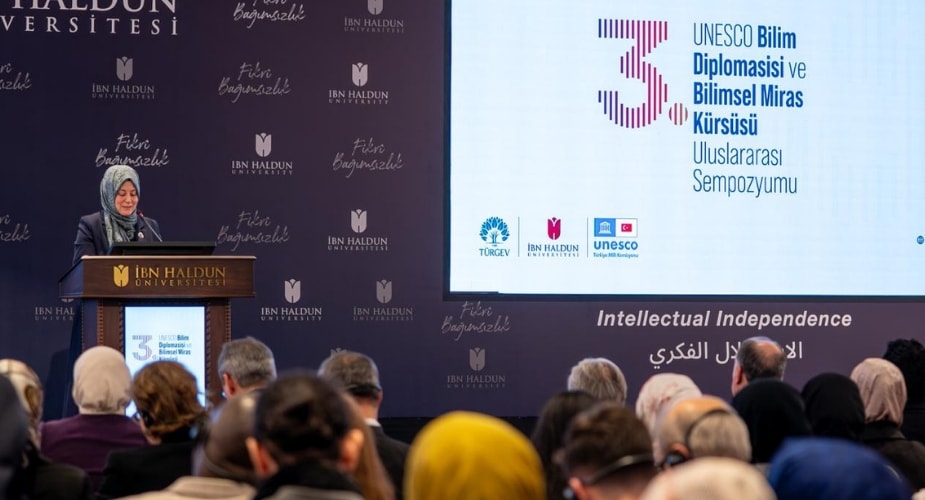
Türkiye Gençlik ve Eğitime Hizmet Vakfı (TÜRGEV), the 3rd International UNESCO Science Diplomacy and Scientific Heritage Chair Symposium held on November 26-28, 2025, turned Istanbul into the focal point of global scientific interaction for three days. The symposium, themed "Intercontinental Knowledge Flow and Scientific Bridges," hosted 27 academics from 14 countries, including Canada, Colombia, Qatar, Mexico, the USA, and Turkey. The main sessions took place at Ibn Khaldun University.
Türkiye Gençlik ve Eğitime Hizmet Vakfı (TÜRGEV), the 3rd International UNESCO Science Diplomacy and Scientific Heritage Chair Symposium held from November 26 to 28, 2025, turned Istanbul into the center of global scientific interaction for three days. The symposium, themed "Intercontinental Knowledge Flow and Scientific Bridges," hosted 27 academics from 14 countries, including Canada, Colombia, Qatar, Mexico, the USA, and Turkey. While the main sessions were held at Ibn Khaldun University, an Open Science Workshop, a scientific heritage exhibition, and field programs were organized at the Suleymaniye Salis Madrasa with the participation of UNESCO experts.
WE ARE PUTTING AN END TO THE MONOPOLY OF POWER OVER KNOWLEDGE
TÜRGEV Chairperson Av. Hatice Akıncı Yılmaz highlighted the power of knowledge and the necessity of fair circulation in her opening speech: "History shows us that knowledge has never been in a neutral circulation at any time. The places where knowledge is produced and the centers that attribute value to it have often been different; scientific accumulation has sometimes been used as a tool of power and sometimes as a means of political superiority. Limited centers still decide which knowledge is considered 'valuable.' Therefore, we must revisit epistemic justice and the global knowledge architecture."
Yılmaz emphasized that knowledge is the common heritage of humanity, stating, "It develops in the coexistence of different cultures, cities, languages, and times. The vast civilization line extending from Basra to Cordoba, from Damascus to Mexico City has built today’s scientific infrastructure with silent, deep, and decisive contributions," highlighting Turkey's historical role in the scientific world.
In her speech, Yılmaz also referenced the vision of the late Prof. Dr. Fuat Sezgin, emphasizing that knowledge is the strongest resource shaping the confidence and future of societies.
YOUNG GIRLS WILL BE THE PIONEERS OF THE SCIENCE ECOSYSTEM
Yılmaz articulated the approach that forms the basis of TÜRGEV's youth vision as follows: "As the access of our youth to science, their research capacities, and their opportunities to participate in international discussions are strengthened, the horizons of countries expand, and the transformation capacity of societies increases. We are working to make our young girls the subjects of science, culture, and international academic networks as TÜRGEV."
As a strong example of this vision, Elif Leyal Uğraş, who represented Turkey as the youngest researcher in Mexico last year, was among the speakers in Istanbul this year.
ACADEMIC PARTNERSHIPS STRENGTHENED GLOBAL COOPERATION
The Academic Board of the symposium was formed with the participation of academics from Turkey, Latin America, and the Gulf region. The board included Prof. Ana María Cetto, Prof. Ahmet Karakaya, Prof. Hasan Umut, Prof. Mashhoor Alwardat, Prof. Tuncay Zorlu, and Prof. Vahdettin Işık.
The organizing committee consisted of representatives from UNESCO–UNAM, Sharjah University, Ibn Khaldun University, and TÜRGEV. In the committee, TÜRGEV was represented by Semanur Yavan Batcı, Serap Özden, and Zeynep Tuzcu.
A JOURNEY INTO ISTANBUL'S SCIENTIFIC HERITAGE AT THE SYMPOSIUM
On the second day of the symposium, participants visited the Suleymaniye Mosque to examine the architectural and scientific dimensions of the structure. The program concluded with a closing ceremony at GİF Safveti Pasha Campus and thank-you plaques from TÜRGEV General Director Dr. Selim Gençal.
PIONEERING STEPS FROM TURKEY IN INTERCONTINENTAL KNOWLEDGE DIPLOMACY
During the panels held throughout the symposium, topics such as 'The Future of Scientific Bridges, Digital Knowledge Networks, Epistemic Justice, Global South's Knowledge Infrastructures, and Scientific Interaction between the Islamic World and Latin America' were discussed. Participants shared the common view that the symposium provided an inspiring and strategic contribution to international science diplomacy for young researchers. This meeting, emphasizing that science is a common good for humanity, further strengthened Turkey's visibility in science diplomacy. TÜRGEV continues to contribute to strengthening Turkey's science diplomacy capacity through its efforts in the preservation of scientific heritage and the fair circulation of knowledge.