Leading academic institutions and scientists from around the world are gathering in Istanbul, hosted by Türkiye Gençlik ve Eğitime Hizmet Vakfı (TÜRGEV).
The world's leading academic institutions and scientists are gathering in Istanbul under the auspices of Türkiye Gençlik ve Eğitime Hizmet Vakfı (TÜRGEV).
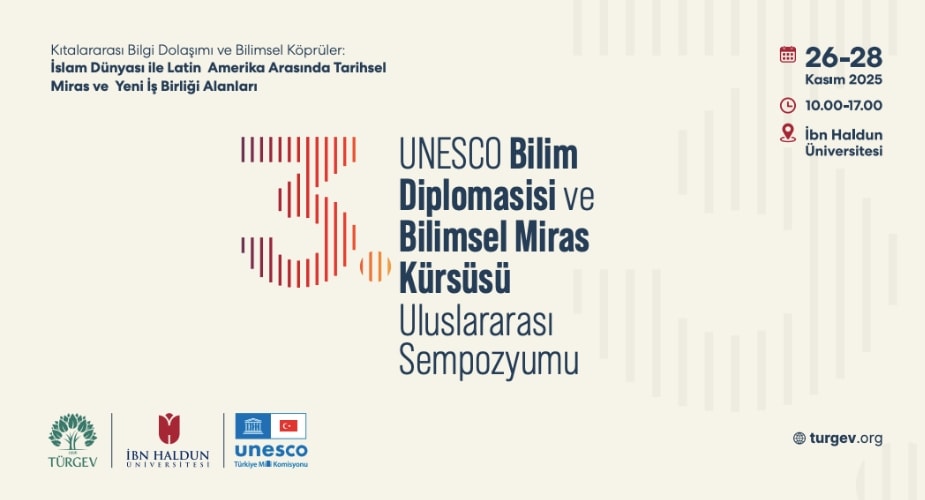
The 3rd UNESCO Science Diplomacy and Scientific Heritage Symposium, to be held from November 26 to 28, 2025, will host 27 distinguished academics from 14 countries this year.
The program, themed "Intercontinental Knowledge Exchange and Scientific Bridges," is making Istanbul one of the centers of intercontinental science diplomacy by uniting the Islamic world and Latin America on the same scientific platform.
TÜRGEV President Yılmaz: "Science is the strongest alliance that nations quietly establish."
TÜRGEV Board Chair Av. Hatice Akıncı Yılmaz expresses Turkey's vision for science diplomacy with the following words:
"Science is the strongest alliance that nations quietly establish. We are proud to host such a comprehensive gathering that elevates our country to a regional science hub as TÜRGEV. Preparing our youth for the global science ecosystem; nurturing their courage, self-confidence, and academic accumulation is both a duty and a responsibility we feel towards the future."
Participation Profile Created by Experts from 14 Countries
The symposium is being held in collaboration with Ibn Khaldun University, the National Autonomous University of Mexico (UNAM), and the University of Sharjah, with the support of TÜRGEV.
This year, academics from Canada, Colombia, Egypt, Jordan, Lebanon, Mexico, Oman, Qatar, Russia, Syria, Switzerland, Turkey, the United Arab Emirates, and the USA are coming together in Istanbul, hosted by TÜRGEV.
This participation profile positions the symposium as one of the rare scientific platforms that brings together the Islamic world and Latin America.
Scientific Staff Composed of Competent Names
Among the academics featured in this year's presentation program are the following names:
Adeela Arshad-Ayaz, Muhammed Ayaz Naseem, Eduardo Erazo Acosta, Fadia Boumjahed, Fatima AlSuwaidi, Fatima Belhaouari, Ammar Alnahar, Anas Chakkalakal, Nesreen A. Abdel Hamid, Raed Hayajneh, Baptiste Brodard, Minal Haddad, Montserrat Marroquín Rodríguez, Sofía Benítez Villalobos, İrek Süleymanov.
Researchers from Turkey include:
Ali Çaksu, Ahammed Ishac C.E., Büşra Fidan Ray, Hafsa Betül Kurtaran, Iklil Athroz Arfan.
This extensive academic staff provides a strong contribution to the symposium both scientifically and culturally.
Academic Committees Managing the Governance Process
The Academic Board of the symposium consists of academics from Istanbul Medeniyet University, UNAM, Boğaziçi University, Ibn Khaldun University, Istanbul Technical University, Fatih Sultan Mehmet Vakıf University, and the University of Sharjah.
Among the board members are:
Prof. Ana María Cetto, Ahmet Karakaya, Hasan Umut, Mashhoor Alwardat, Tuncay Zorlu, and Vahdettin Işık.
In the Organization Committee:
Afşin Murat Taştan, Ayaz Asadov, Besart Thaci, Maamoun Abdulkarim, Mesut Idriz, Montserrat Marroquín Rodríguez, Parsifal Islas-Morale, Semanur Yavan Batcı, Serap Özden, and Zeynep Tuzcu are serving.
Thematic Framework Shaping the Content of the Program
The following panel topics will be discussed over three days:
Decolonized Scientific Bridges
Contemporary Cooperation Platforms
Digital Knowledge Junctions
Information Infrastructures of the Global South
Interactions between the Islamic World and Latin America
Scientific Heritage and Cosmological Approaches
This comprehensive academic endeavor transforms Istanbul into the focal point of intercontinental science diplomacy for three days.